
Published on: 4th March 2026
Each financial year, Deaf Connect funds a diverse range of Deaf-led community initiatives through our Grants and Sponsorships program. These projects range from sport, the arts, festivals, research and more – but they are united by one guiding principle: to celebrate the culture, diversity, and heritage of Deaf Australians.
One of our recent grant recipients is Fiona Murphy, a talented Deaf author based in New South Wales. With funds from a Deaf Connect grant, Fiona undertook a two-week writers residency at the National Writers’ House in the Blue Mountains, developing her skills and creative network.
Fiona has since reflected on what that experience meant to her. We invite you to read her story below and learn more about her upcoming book.

Photograph: Fiona Murphy
Fiona’s story: two-week residency at Varuna
Last June, I packed my bags and drove up to Katoomba. Winter had arrived in the Blue Mountains — the sky was a wide, crisp blue and the air was startingly fresh. I was grateful that I had packed thermals as I would be spending the next 2 weeks at Varuna, the National Writers’ House. The residency was funded by a grant from Deaf Connect.
Writers from across Australia and around the world apply to do residencies at Varuna. Authors often talk fondly about feeling creativity inspired whilst staying in the big, yellow house. I was feeling nervous but excited for the residency, as for the next fortnight I would be working on a new book.
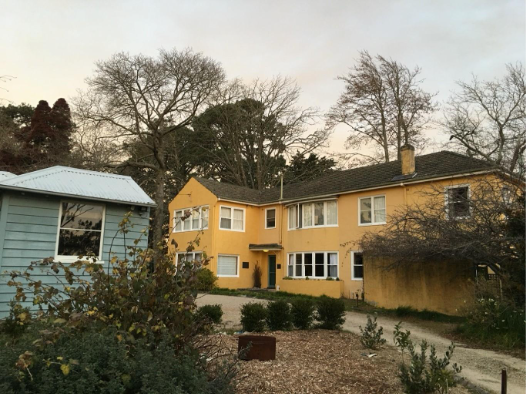
Photograph: Outside the front of Varuna, The National Writers’ House.
Writing a book
I’m currently writing a book called Livelihood: How Deaf people have quietly changed the world. It is a collection of essays about the working lives of Deaf people. As a Deaf person, I have always been obsessed about work. Ever since I got my first job at fifteen years old, my mind has raced with questions, such as:
- When should I disclose my deafness? In my CV? At the job interview? After I get offered a role?
- How should I ask for reasonable adjustments? What I even entitled to ask for? And how can I make sure my colleagues remember these accommodations?
- Will I always feel this burnt out and exhausted working in hearing dominated workplaces?
Having been in the workforce for over twenty years, that last question has become increasingly urgent for me. It always feels like I’m in varying states of burn out — rolling from one illness to next and never quite recovering or having to decline social plans just so I have enough energy for the work week. Whenever I catch up with Deaf friends, it is something that inevitably crops up in conversation: the sheer exhaustion that we all feel. And this isn’t a niche problem. The Deaf unemployment gap is growing. Deaf people are unable to enter the workforce, or they are being pushed into premature retirement.
For the past two years, I’ve been interviewing Deaf people, diving into archives, unearthing research papers and reading countless books. I have learned so many incredible things throughout my research, including countless stories of how Deaf people have changed the world while working in fields as varied as science, medicine, agricultural, cinema, literature, plus many more.
I arrived at Varuna with high hopes of weaving all this research material into a cohesive and compelling story.
What happens at a writers’ residency?
At any one time, there are up to six writers staying at Varuna. Everyone has their own room, which is equipped with a writing space and a bookshelf of fantastic books. Varuna has a few rules that everyone staying there must follow, includes keeping the house quiet during the day. Each night all the writers gather for a shared meal. During the meal it is common for writers to talk about their projects, as well as share writing tips, wins and worries.
I never thought I could become a writer. As a child I had struggled to learn how to read and write. With an extraordinary amount of supports and perseverance I finally became literate. Becoming friends with writers has allowed me to understand that most writers take YEARS to write a book. Some admit that they are completely reliant on spellcheck. Discovering that it is normal for writing to be a messy process was an enormous relief. I now embrace the mess!
Because I was staying at Varuna for 2 weeks, I created a work plan. Having realistic goals helps minimise the feelings of overwhelm. As well as ensured that that I was making consistent progress.
My workplan was broken up into three main areas:
- Writing time: My goal was to write new words every single day. This may sound like a simple goal, but it is so easy to spend an entire day polishing previously written words.
Instead of having a daily word count to aim for, I had the goal of writing 15,000 words by the end of the residency. Some days I wrote thousands of words; other days I pecked out a couple hundred words. Having one big goal stopped me feeling demoralised when some writing days felt tougher than others.
- Reading time: Reading is the most important thing a writer can do. It can be both inspiring, as well as instructive. Anytime I have felt like I’ve had “writers block” is when I’ve deprioritised reading. So, to avoid the agony of sharing at a blank Word document, I make sure I spend time reading every day.
- Thinking time: researchers from Stanford University found that on average the creative output of people increased by 60% after they went for a walk compared to sitting. Each day I wrapped myself up in warm clothes and went for a walk.
What’s next?
I still have many drafts and redrafts to do before the book is finished. Plus, there are so many more research rabbit holes I want to explore!
Past Work: The Shape of Sound
If you’re interested in reading more about this work, you can purchase Fiona’s past book, The Shape of Sound here.